
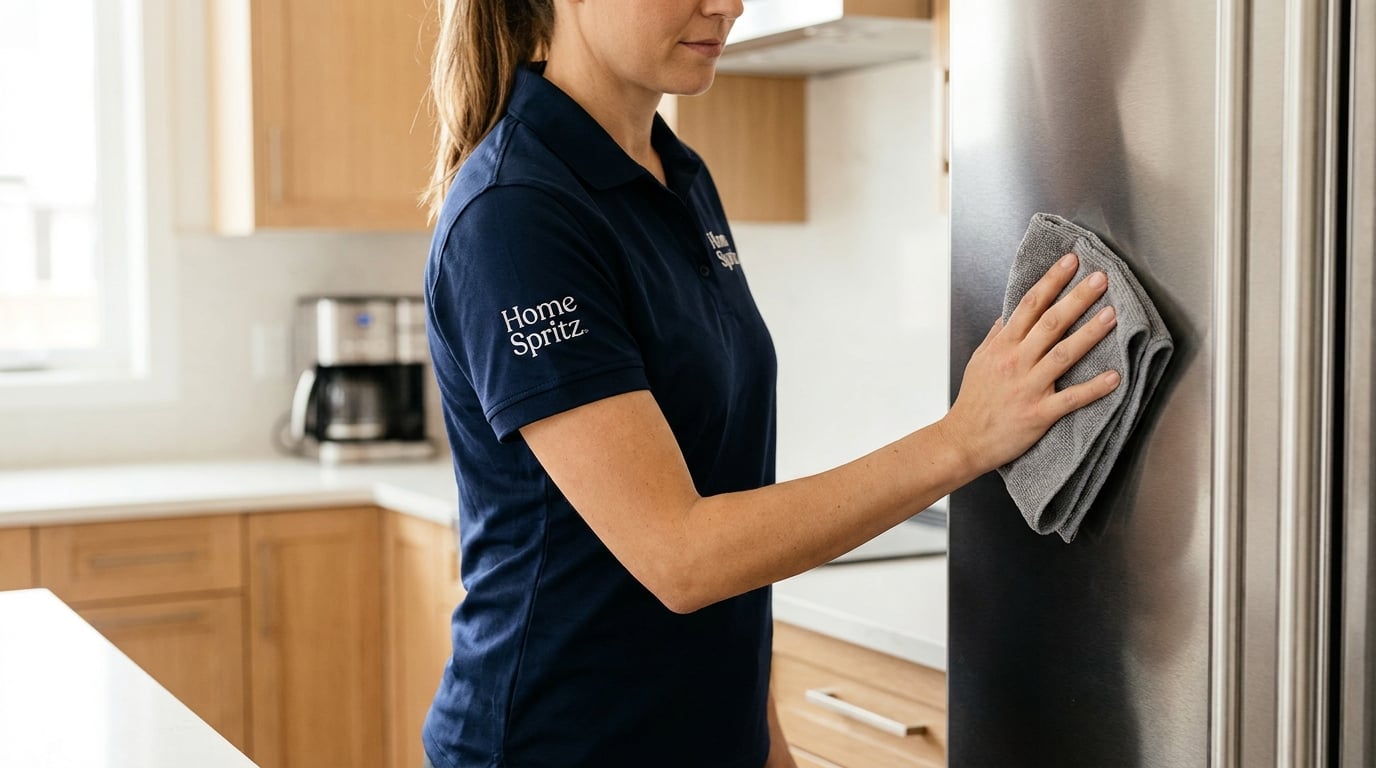
Keeping stainless steel appliances looking flawless in a bustling Toronto kitchen often feels like an endless battle against smudges and streaks. No matter how hard you scrub or what expensive, chemical-heavy polishes you try, you frequently end up with cloudy, hazy surfaces that highlight every single greasy mark, leaving the heart of your home looking perpetually dirty and unkempt. The secret to restoring that breathtaking showroom shine isn’t a magic spray or an exhausting scrub—it is mastering the simple, expert technique of stainless steel appliance grain wiping, a fundamental method our professional cleaners use every day to guarantee pristine, scratch-free results for Canadian families.
- Always follow the brushed metal grain: Wiping parallel to your appliance’s microscopic metal grooves prevents dirt from getting trapped and ensures you never accidentally cause permanent circular scratches.
- Ditch the harsh chemical cleaners: A damp microfiber cloth is usually all you need for the fridge, while 1 drop of Dawn dish soap and warm water is the ultimate safe solution for surrounding counters and floors.
- Buff with a dry cloth for a brilliant finish: Following up your damp wipe with an immediate dry microfiber buff (always going with the grain) is the fastest way to eliminate fingerprints and water spots permanently.
What is Directional Brushed Metal Grain on Stainless Steel? (And Why Does It Matter?)
If you look closely at your refrigerator, dishwasher, or oven, you will notice that the surface is not entirely smooth like a standard mirror. Instead, it features a series of extremely fine, continuous lines that run uniformly across the surface. This is known as the brushed metal grain. During the manufacturing process of high-end appliances, abrasive materials are used to polish the stainless steel, leaving behind these microscopic grooves. Understanding this texture is the foundational rule of proper stainless steel appliance grain wiping in Toronto homes.
Why does this matter for your daily cleaning routine? Because those tiny grooves act like microscopic valleys. When you wipe against the grain (perpendicular to the lines) or use frantic circular motions, you are essentially forcing dust, kitchen grease, and cleaning residue deeper into those valleys. This trapped debris is exactly what causes the dreaded cloudy haze and persistent streaking that frustrates so many homeowners. Worse yet, if there is a tiny particle of hard debris on your cloth, rubbing in circles or against the grain will etch permanent, visible scratches into the steel, ruining the premium look of your appliance.
By simply aligning your wiping motion to run parallel with these natural lines, your cloth glides smoothly over the surface, effortlessly lifting away grease and grime rather than packing it down. This seemingly small adjustment to your chore routine can transform the look of your kitchen. For those managing a hectic lifestyle, adopting these pro-level habits is essential. If you are looking to streamline your entire household routine, we highly recommend exploring our comprehensive Toronto house cleaning: a guide for busy professionals to help reclaim your weekend.
How Can You Identify Your Appliance’s Grain Direction? (Quick Visual Tests)
Before you even pick up a cloth, you must become a kitchen detective and identify the direction of the grain. Fortunately, it only takes a few seconds and a keen eye. Stand about a foot away from your appliance and ensure the kitchen is well-lit—natural sunlight or bright overhead lighting works best.
Look closely at the flat expanse of the metal. You will see faint, silvery striations. In most modern refrigerators, dishwashers, and ovens, the grain runs completely horizontally or completely vertically. On large, tall surfaces like a French-door refrigerator, the grain is overwhelmingly likely to run vertically (up and down). However, on oven doors, microwaves, or warming drawers, horizontal grains (left to right) are incredibly common.
It is crucial not to assume that every piece of metal in your kitchen follows the exact same pattern. The handle of your refrigerator might have a vertical grain while the door itself has a horizontal one. Knobs, control panels, and custom range hoods can all vary based on how the manufacturer cut and polished the steel. If you are struggling to see the lines, take a dry piece of soft microfiber and gently lightly wipe a two-inch section vertically, then horizontally. You will feel slightly less resistance when you are moving with the grain.
Taking the time to accurately assess these surfaces protects your investment. If you ever feel overwhelmed by the meticulous care required for high-end kitchen finishes, remember that professional help is just a click away. Engaging a reliable Toronto maid service for spotless homes ensures that every surface—from delicate stainless steel to finicky natural stone—is treated with the exact care and expertise it demands.
What Are the Best Microfiber Cleaning Techniques for Stainless Steel? (Avoiding Scratches)
The tools you use are just as important as the direction in which you wipe. Paper towels, rough sponges, and standard cotton rags are the enemies of brushed stainless steel. Paper towels leave behind lint that gets trapped in the grain, while rough sponges can easily cause micro-scratches. The absolute best tool for this job is a high-quality, plush microfiber cloth.
Microfiber is engineered to attract and hold onto grease, dust, and moisture without scratching delicate finishes. When tackling your appliances, you should utilize a two-cloth system. Your first cloth should be slightly damp. For light daily touch-ups, plain warm water is perfectly sufficient. Start at the top of the appliance and work your way down, wiping in straight, deliberate lines that perfectly match the direction of the grain. Never use circular “wax on, wax off” motions.
If you are also cleaning the rest of your kitchen, it is vital to adhere to strict, safe cleaning product rules. For nearby floors and standard counters, the ultimate mixture is simply 1 drop of Dawn dish soap combined with warm water. If your aggressive wiping splashes anything onto adjacent wooden cupboards or painted walls, immediately wipe it away with plain warm water on a damp microfiber cloth—nothing harsher should touch your cabinetry.
Crucially, you must avoid harsh chemicals. Never use bleach on your appliances, counters, or sinks. Bleach is highly corrosive to stainless steel and is strictly for toilet bowls ONLY. Similarly, keep vinegar away from your general wiping routine. Vinegar should be used for hard water mineral scale ONLY (such as the crusty buildup around your fridge’s water dispenser), and it must never touch stone counters or hardwood floors. Utilizing these safe, non-toxic methods not only protects your home but also perfectly aligns with the principles of eco-friendly cleaning services in Toronto & GTA, keeping your family safe from toxic fumes.
How Do You Remove Fingerprints from Stainless Steel Safely? (Without Harsh Chemicals)
Fingerprints are the bane of the modern kitchen. The natural oils from our hands adhere instantly to stainless steel, and because the metal reflects light, these smudges are broadcasted to anyone walking into the room. Removing them doesn’t require specialty oil-based polishes, which often just layer more grease onto the surface, compounding the problem over time.
The safest and most effective way to banish fingerprints is the “damp-then-dry” microfiber method. If a fingerprint is particularly greasy (perhaps from cooking with butter or olive oil), dampen your first microfiber cloth and add the tiniest fraction of a drop of Dawn dish soap. Dawn is formulated specifically to cut through kitchen grease without leaving a heavy residue. Gently swipe the soapy, damp cloth over the fingerprint, perfectly parallel to the grain.
Immediately—before the water has a chance to air dry—take your second, completely dry microfiber cloth and buff the area, again strictly following the grain. This dry buffing step is the true secret weapon. It absorbs the remaining moisture and lifts away any emulsified oils, preventing water spots and leaving behind a brilliant, mirror-like finish. By relying on the physical structure of the microfiber rather than harsh synthetic chemicals, you maintain the pristine integrity of the steel while ensuring a food-safe environment for your family.
Frequently Asked Questions (FAQ) About Cleaning Stainless Steel in Toronto
Can I use vinegar to clean my stainless steel fridge?
You should only use vinegar on your stainless steel appliances to tackle hard water mineral scale, such as the chalky white buildup around your refrigerator’s water and ice dispenser. For general fingerprint removal and daily wiping, stick to a damp microfiber cloth. Remember, vinegar is acidic; it should never be used on general surfaces, stone countertops, or hardwood floors.
Is it safe to use bleach to disinfect my stainless steel sink or appliances?
Absolutely never. Bleach is highly corrosive and will cause irreversible damage, pitting, and rust on stainless steel surfaces. At Home Spritz, our strict rule is that bleach is meant for toilet bowls ONLY. Never use it for general surface cleaning in the kitchen.
What is the best way to clean the floors and counters around my stainless steel appliances?
The safest, most effective cleaner for your surrounding kitchen floors and countertops is simply 1 drop of Dawn dish soap mixed into warm water. This gentle solution cuts through grease without damaging your finishes. For nearby cupboards and walls, plain warm water on a damp microfiber cloth is all you need.
Why does my stainless steel look cloudy after I clean it?
Cloudiness or hazing is almost always caused by wiping against the grain, wiping in circular motions, or using too much product. Excess polish or soap residue gets trapped in the microscopic grooves of the brushed metal. To fix this, wipe the appliance down with a damp microfiber cloth (using plain warm water) parallel to the grain, and immediately buff it dry with a clean microfiber cloth.